Duong Lam Ancient Village preserves the ancient beauty of traditional Vietnamese villages and has become an attractive tourist destination in Hanoi. Recently, a new service has emerged in the ancient village: buffalo cart tours, offering a unique and intimate experience. This service, when introduced, will not only attract tourists but also open up a unique and friendly direction for tourism development.
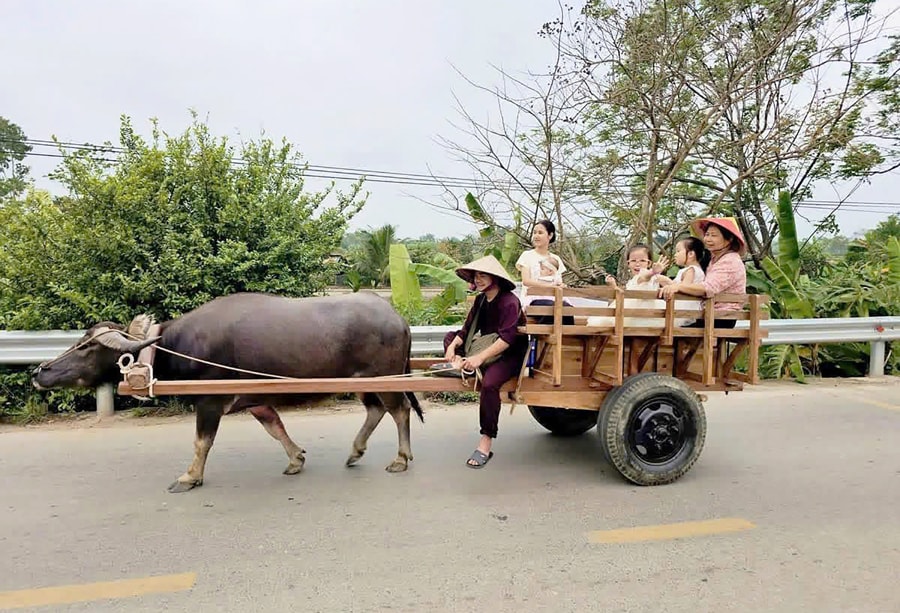
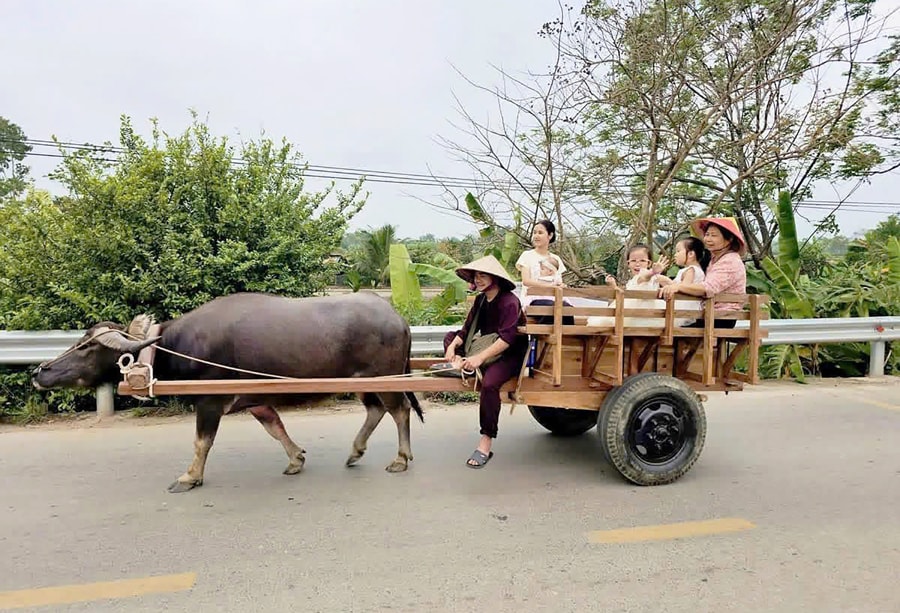
Tourists experiencing buffalo cart tours in Duong Lam Ancient Village.
"Revitalizing" rural tourism
Recently, when visiting Duong Lam Ancient Village (Son Tay Ward, Hanoi), many tourists are quite surprised to experience a village tour by buffalo cart. Serving visitors is a very friendly buffalo that, following its owner's commands, can use its horns to lift the yoke onto its shoulder to begin the journey. This novelty is helping Duong Lam Ancient Village create a more memorable experience for tourists.
The person behind the initiative to launch the buffalo cart experience service is Mr. Ha Ke Dung, a resident of Mong Phu village with many years of experience in the tourism sector. Mr. Dung said that his childhood spent in the ancient village made him love every alley, every house, and he was also very familiar with farming, buffalo herding, and grass cutting. As an adult, with his deep love and beautiful memories of the ancient village, along with his knowledge and experience in tourism, he decided to integrate village culture into local tourism development.
“Over time, the ancient houses of the village have gradually disappeared, and farming activities like buffalo herding and plowing are no longer as common. As a son of the village, I really want to recreate the beauty of Vietnamese rural life for tourists, especially the beauty of the ‘laterite stone village.’ I thought about introducing the image of the buffalo – a symbol associated with the countryside and the purely agricultural life of Vietnamese people in the past,” Mr. Dung shared.
After consulting with friends and tourism experts, Mr. Ha Ke Dung decided to "buy a buffalo" to realize his idea.
However, introducing buffalo carts for tourism was not simple. First, he had to choose a gentle, domesticated buffalo that was friendly to humans. Mr. Dung spent a long time searching before finding a suitable one. Once he had the buffalo, he needed someone to care for it and lead it professionally. The buffalo not only had to be domesticated but also kept clean, friendly, and safe. The buffalo leader also acted as a guide, providing information about the ancient village to tourists.
Recalling the early days of the service, Mr. Dung said that because the ancient village of Duong Lam is currently small, raising buffaloes within the village was inconvenient, so he had to build a barn on the outskirts of the village. The buffalo barn for tourism also had to be specially designed to ensure good care conditions. “It took quite a bit of effort for me to witness my buffalo leisurely carrying tourists around the village,” Mr. Dung shared.
Enhancing the tourist experience
After a long period of preparation, the buffalo cart service officially began operating in Duong Lam ancient village after the Lunar New Year of the Year of the Horse. During the spring festival season, the number of tourists visiting the village increased significantly, with many international groups and families with young children showing great interest in experiencing the buffalo cart ride around the village. Each trip carries about 8-10 people, and tourists can take photos with the buffalo, feed them, and leisurely enjoy the fresh air and the ancient cultural features still preserved in the ancient village.
Mr. Ha Ke Dung said that tourists can sit on the buffalo cart and admire the village temple, the centuries-old houses along the main axis of Mong Phu hamlet, or combine exploring the ancient village with admiring the surrounding rice fields. This area also boasts many beautiful and famous historical sites, especially the Lo Bieu Pavilion – a structure that has been featured in numerous photographs and paintings.
After experiencing a buffalo cart ride with her family, Ms. Nguyen Thu Thanh (Thanh Xuan) shared: “The buffalo is closely associated with plowing fields and farming, very familiar to farmers. However, due to industrialization, we see fewer and fewer buffaloes in the suburbs. Therefore, I let my children experience a buffalo cart ride in the ancient village. The children were all delighted with this practical trip.”
Ms. Sui Mei Lin, a tourist from the Philippines, commented: “People always say that the buffalo is an image associated with Vietnamese rural life. Therefore, when we got to ride a buffalo cart and admire the countryside, my friends and I were very excited. We felt a sense of closeness and authenticity while learning about the rural culture here.”
Commenting on the trial operation of ox carts for tourism in Duong Lam ancient village, Nguyen Dang Thao, Director of the Son Tay Cultural and Information Center, said that currently, this service is limited to transporting tourists as a means of transportation and is being considered by the local authorities regarding its feasibility, especially safety. However, Mr. Nguyen Dang Thao also noted that if ox carts were developed in conjunction with agricultural tourism experiences, such as serving tours of rice fields or participation in rural activities, this model could be more effective.







.png)